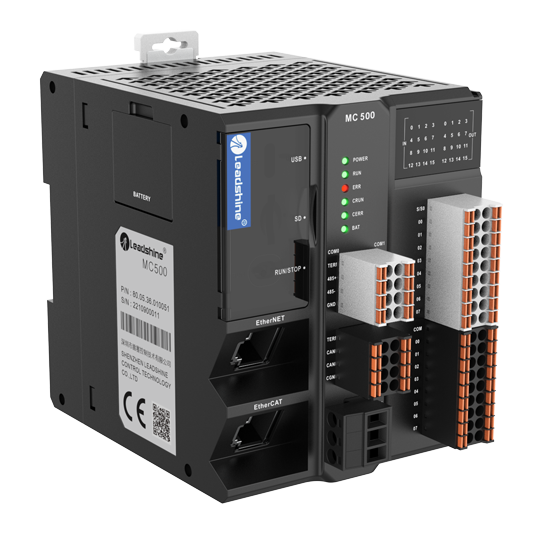
The landscape of industrial automation has undergone a radical transformation over the last few decades. The days of massive control cabinets filled with hundreds of hardwired electromechanical relays are largely behind us, replaced by the compact, intelligent power of the industrial PLC (Programmable Logic Controller). As factories race toward Industry 4.0, the role of the PLC has evolved from a simple logic handler to a sophisticated automation hub. Modern PLCs, such as those engineered by Leadshine, offer a suite of competitive advantages—ranging from integrated motion control to hyper-connectivity—that enable manufacturers to build faster, smarter, and more reliable machines.
The Convergence of Logic and Motion
Historically, logic control and motion control were treated as separate disciplines requiring separate hardware. A standard PLC handled sensors and switches, while a dedicated motion controller managed servo drives. One of the primary advantages of a modern industrial PLC is the convergence of these two functions into a single, powerful unit. The Leadshine MC series, for example, integrates advanced PLC motor control capabilities directly into the CPU. This means a single device can execute complex logic sequences while simultaneously managing multi-axis interpolation, electronic cams (E-CAM), and rotary flying shears. This integration drastically reduces hardware costs, simplifies wiring, and eliminates the communication latency that often plagues multi-controller architectures.
Unmatched Processing Speed and Precision
In high-speed manufacturing, every millisecond counts. Modern PLCs have moved beyond the slow cycle times of their predecessors, adopting multi-core processors capable of nanosecond-level instruction execution. Leadshine has leveraged this computing power to create PLCs that can process logic instructions in as little as 7 nanoseconds. This speed is critical for high-performance PLC motor control, where the system must calculate trajectories and update drive positions thousands of times per second. Such responsiveness ensures that machines can run at higher throughput rates without sacrificing precision, a crucial edge for industries like semiconductor manufacturing and packaging.
Seamless Connectivity for the Smart Factory
The modern industrial PLC is no longer an island; it is a node in a vast, interconnected network. Competitive advantage today is defined by how well a machine communicates with the rest of the factory. Leading PLCs now support open, high-speed industrial Ethernet protocols natively. Leadshine PLCs, for instance, come standard with EtherCAT support, allowing them to control up to 32 servo axes with microsecond-level synchronization. Furthermore, support for protocols like Modbus, CANopen, and Ethernet/IP ensures that these controllers can seamlessly exchange data with SCADA systems, and other third-party devices. This connectivity is the backbone of the Industrial Internet of Things (IIoT), enabling real-time data collection and remote monitoring.
Scalability and Flexible Architecture
Flexibility is another key differentiator. Manufacturers often build a range of machines, from simple standalone stations to complex assembly lines. A modern industrial PLC platform offers a scalable architecture that grows with the application. Leadshine addresses this with a dual-series approach: the compact SC series for cost-sensitive, space-constrained applications, and the robust MC series for high-end performance. Both series utilize a “LEGO-like” expansion module system, allowing engineers to add specific I/O, temperature sensing, or communication modules as needed. This modularity prevents over-specification, ensuring that OEMs only pay for the functionality they actually require while retaining the option to upgrade later.
Advanced Algorithms for Complex Applications
Beyond raw speed, the “intelligence” of a PLC is defined by its software capabilities. Modern controllers come pre-loaded with industry-specific algorithms that drastically reduce development time. Instead of writing code from scratch to control a robotic arm or a winding machine, engineers can utilize pre-built function blocks. Leadshine excels in this area by incorporating specific process libraries into their PLC motor control firmware. Whether it is a delta robot trajectory algorithm or a tension control block for a printing press, these built-in tools allow engineers to focus on the unique aspects of their machine rather than reinventing the wheel for standard motions.
Durability and Industrial Hardening
Despite their advanced computing power, modern PLCs have not sacrificed ruggedness. In fact, they are more durable than ever. An industrial PLC must withstand environments that would destroy a standard PC—extreme temperatures, vibration, dust, and significant electromagnetic interference (EMI). Leadshine designs their PLCs with rigorous isolation and protection circuits, ensuring stable operation even in “noisy” electrical environments where large motors and drives are constantly switching. This reliability reduces unplanned downtime, which is often the single most expensive cost factor in manufacturing.
Cost-Effectiveness Through Innovation
Finally, the competitive advantage of modern PLCs is evident in their value proposition. The miniaturization of electronics and the integration of features have driven down costs while driving up performance. By combining the PLC, motion controller, and often the HMI (Human-Machine Interface) logic into one ecosystem, suppliers like Leadshine offer a total solution that is significantly more affordable than the disjointed systems of the past. This cost-effectiveness allows even small to medium-sized manufacturers to implement sophisticated PLC motor control automation that was previously the domain of large automotive or aerospace giants.
The Foundation of Future Automation
In summary, the modern industrial PLC serves as a sophisticated convergence of control technology, integrating the reliability of traditional hardware with the capabilities of modern computing.By unifying logic and motion, offering blazing-fast processing speeds, and ensuring seamless connectivity, these devices provide the competitive edge necessary to succeed in today’s market. For machine builders and system integrators, partnering with a forward-thinking supplier like Leadshine—whose products embody these advancements—is the strategic choice for creating the efficient, reliable, and high-performance automation systems of tomorrow.