Organizations sourcing shelter for disaster response or short-term emergency housing do not shop for tents the way an outdoor retailer’s customers do. Cost per unit, storage footprint, and setup speed under stress tend to matter more than aesthetics, and sourcing usually starts with a checklist of hard requirements rather than a browsing session.
Large-capacity tents built for the consumer market sometimes enter this conversation, since a glam camping tent that sleeps a dozen people appears to solve the same space problem a relief agency faces. Consumer products and purpose-built emergency shelters are not interchangeable by default, though, so it helps to be specific about where the overlap holds.
Space Per Person Is the First Number That Matters
Emergency shelter planning typically starts with square footage per occupant rather than a headcount, since a “12 person” label can mean very different amounts of usable floor space depending on how the figure is calculated.
THECATAL’s Magic Fort is a duplex-layout basecamp tent with 484 square feet (40 square meters) of interior space, built for 12 or more people. At 12 occupants that works out to roughly 40 square feet each, a number to compare against the minimum space standard of the relief organization or shelter guideline in use. The interior can be divided into separate rooms, which keeps sleeping, storage, and gathering areas apart, and the 3.5 m (137.8 in) height leaves room to stand.
Setup Time Under Realistic Conditions
The Magic Fort can be set up in under 10 minutes. A first pitch by volunteers without training, working in the dark or in rain, will usually take longer. Emergency deployment plans benefit from a margin on that figure, and from one trial pitch before an event, so that the crew has handled the tent at least once before conditions turn difficult.
Portability and Storage Footprint
Emergency shelter stock has to be stored between events, often in large volume, which makes packed size as relevant as weight. Packed, the Magic Fort takes up about one third of a typical vehicle trunk. That is the kind of volume figure a logistics planner can use directly, since warehouses and transport vehicles are usually limited by volume before weight.
Organizations comparing several large tents for pre-positioned stockpiles get a clearer picture by collecting packed-volume figures for each candidate, not only the headline square footage.
Ordering, Shipping, and Lead Time
Large shelters raise logistics questions that a unit price does not answer. THECATAL’s Magic Fort product page states that its shipping approach depends on the size of the package and directs buyers to customer service for shipping details. Freight cost and delivery method for a multi-unit order should therefore be confirmed in writing before purchase.
The company’s site describes its products as in mass production, which is a reasonable opening for a lead-time conversation but not a delivery commitment. Stock status on a product page can also change, so availability for the quantity needed should be confirmed directly.
THECATAL also runs a wholesale and retailer partnership page, inviting retailers, distributors, and partners to request a wholesale catalog and terms by email. That page is framed around retail and distribution. An agency or relief organization should ask directly whether institutional bulk orders are handled and on what terms, rather than assume the wholesale route applies.
Weather Performance Worth Verifying
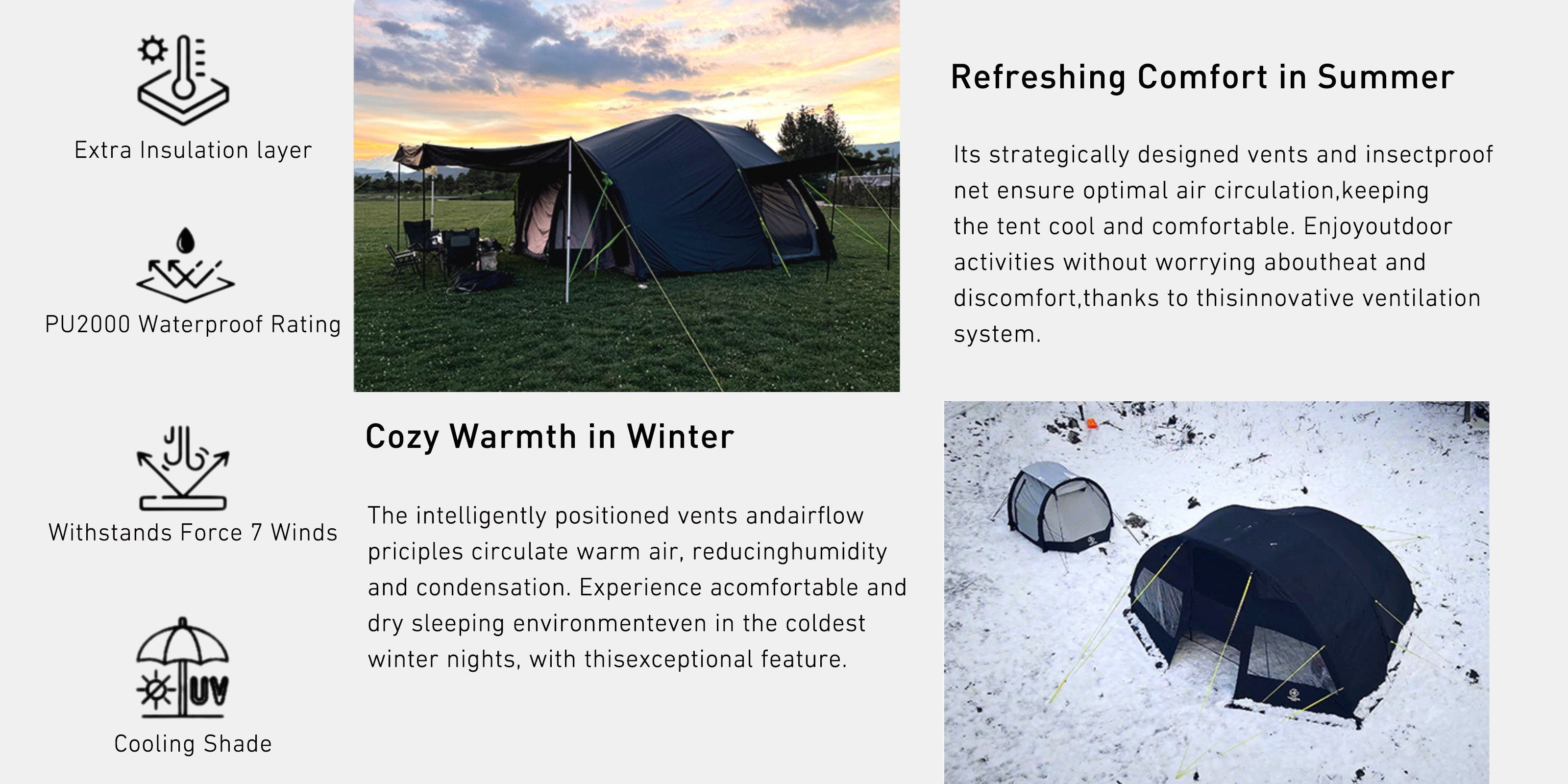
The Magic Fort is built for year-round use. It is waterproof, windproof, snow-proof, and heat-resistant, and its fabric is silicone-coated 70D nylon. Two-way zippers on both sides are compatible with heating devices, and the tent vents gases while a heater is running. Any heater in an enclosed shelter calls for ventilation and a working carbon monoxide alarm.
For emergency use, where conditions may be harsher than on a typical camping trip, buyers should confirm with the manufacturer how the tent performs against their own requirements, such as expected wind speed, rainfall, and snow load at the deployment site.
What a Consumer Product Does Not Cover
The Magic Fort is a glamping and basecamp tent. Formal emergency shelter procurement, for example through national disaster response agencies, often calls for specific certifications, fire-retardant ratings, or field-durability testing, and a consumer tent is not built around those requirements. Buyers with formal procurement rules should ask whether a given tent meets them before relying on it.
That does not rule out a product like the Magic Fort for lower-stakes situations, such as a temporary community gathering point or a short-term family displacement. It does mean that product specifications are a starting point for further verification, not a substitute for it.
Building a Sourcing Comparison
A simple table across candidate products works well: square footage per occupant, setup time, packed volume, fabric type, and weather ratings, with a note on which figures come with a specific tested number and which are general descriptions.
A 12 person camping tent like the Magic Fort supplies several of those data points: 484 square feet of space, setup in under 10 minutes, a packed size of about one third of a trunk, and 70D silicone-coated fabric. That makes it a reasonable benchmark against other large-capacity tents, even for buyers who ultimately need a more specialized, certified product. THECATAL backs it with a two-year warranty, another item worth adding to the comparison.
Treating manufacturer specifications as the start of due diligence, not the end of it, is the sounder approach when the shelter may house people during a real emergency rather than a planned camping trip.