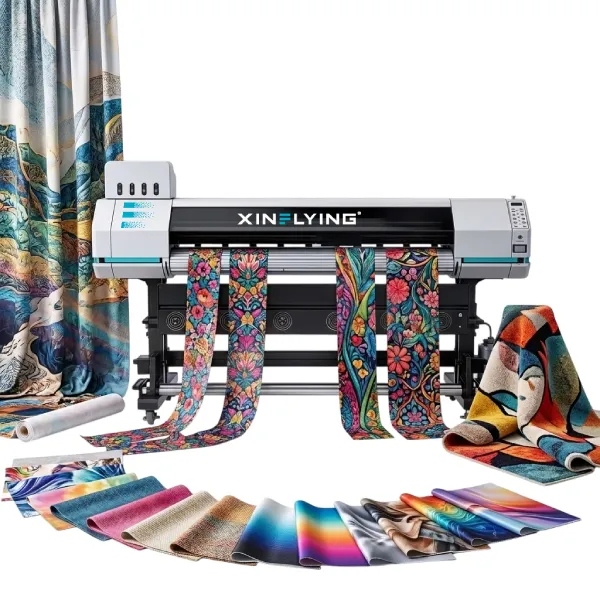
Transforming digital artwork into durable textile graphics requires controlled heat transfer technology. Utilizing modern sublime printing methods allows industrial fabric processors to yield detailed imagery with smooth tone shifts across synthetic substrates.
Industrial systems rely on piezoelectric printhead technology to release micro-droplets with extreme accuracy. High-density nozzle arrangements allow equipment to maintain consistent drop placement across broad media spans, preventing visible banding on continuous roll runs.
High-Precision Image Transfer Mechanisms
Piezoelectric driving elements generate accurate pressure pulses that force minute ink drops through micro-nozzles. Controlling droplet size dynamically enables machinery to construct fine line work alongside solid color fills without blurring edge boundaries.
Linear encoder scales monitor carriage movement continuously to preserve lateral drop positioning. Microscopic adjustments made during high-speed passes keep multi-pass prints aligned across wide media widths.
Color Fidelity and Micro-Gradient Performance
Achieving vivid color reproduction depends on precise drop volume management during ink application. An advanced Sublimation Printer utilizes variable droplet technology to balance smooth skin tones alongside bold solid tones across complex graphics.
Expanded ink gamuts expand color reproduction options for specialized sportswear and soft signage. Consistent ink viscosity combined with optimized heating zones stabilizes color density throughout extended production schedules.
Substrate Versatility in Synthetic Textiles
Polymer materials respond exceptionally well to disperse dyes during high-temperature processing. Equipment solutions provided by Xinflying cater to polyester fabrics, flag materials, and coated rigid substrates required for custom displays.
Fabrics processed via digital heat transfers retain natural breathability because color pigments bond within the fiber structure rather than forming a rigid surface coating. This capability makes synthetic textile processing highly suitable for activewear and home furnishings.
Thermal Activation and Fiber Integration
Exposing disperse dyes to temperatures near 200°C converts solid ink particles into gas without passing through a liquid phase. Executing sublime printing under precise heat press pressure opens polyester polymers to receive gaseous dye molecules.
Cooling seals the polymer structure around the trapped pigment particles, resulting in water-resistant graphics. The finished fabric resists fading and peeling during repeated washing, maintaining graphic integrity over long service cycles.
Hardware Stability and Mechanical Engineering
Continuous commercial output demands structural rigidity to prevent operational vibration during rapid carriage passes. Solid frame construction housing an industrial Sublimation Printer keeps linear motion guides balanced across high-speed cycles. This mechanical robustness ensures micron-level droplet placement consistency, eliminating banding and registration errors that otherwise compromise final transfer fidelity.
Heavy-duty feed rollers prevent paper buckling during continuous roll feeding. Stable media tensioning preserves spatial proportions across lengthy print runs. By absorbing carriage-induced inertia and dampening external floor vibrations, the rigid chassis minimizes component fatigue, prolonging guide-rail and bearing service intervals.
Printhead Technology and Precision Output
Industrial textile systems incorporate high-density printhead configurations to execute rapid production runs. Incorporating single-head configurations like the Epson i3200-A1 allows compact commercial units to deliver detailed graphics while managing operational costs.
Engineered models like the XF-H1301X utilize this head technology to output smooth gradients and sharp line details. Precise firing frequencies preserve droplet shape across high-speed passes.
Ink Flow Management and Nozzle Protection
Maintaining continuous ink delivery prevents nozzle clogging and line drops during automated production. Manufacturers like Xinflying integrate negative pressure systems and ink degassing modules to optimize fluid movement. Consistent ink flow and proactive nozzle maintenance translate directly into higher first-pass yield rates, minimizing costly reprints and unplanned downtime during high-speed runs.
Automated cleaning stations preserve nozzle plate integrity by clearing dried ink residues between operational shifts. Protecting critical printhead surfaces reduces manual intervention and extends overall equipment longevity. This closed-loop fluid management approach not only safeguards print quality across extended production cycles but also reduces consumable waste from purge cycles, delivering tangible savings in both ink and maintenance labor.
Operational Workflow and System Efficiency
Integrating digital raster image processors simplifies color profile adjustments and file layout preparation. Adapting sublime printing hardware into existing production lines drastically reduces setup times compared to traditional screen preparation.
Compact single-head machinery like the XF-H1301X allows textile print shops to execute short orders alongside rapid prototyping efficiently. Rapid file processing enables quick turnarounds for customized apparel batches without incurring excessive material waste.
Environmental Performance and Resource Savings
Water-based dye inks minimize harmful solvent emissions during printing and heat fixation. Running a modern sublimation printer requires fewer chemical wash cycles, lowering wastewater volume compared to conventional rotary screen dyeing. This shift not only eases regulatory compliance but also reduces water-treatment burdens for production facilities.
Lower energy consumption combined with reduced fabric waste supports greener operational standards in commercial textile manufacturing. Streamlining material consumption directly lowers production overhead across small and large orders.
Conclusion
Digital heat transfer technology reshapes commercial textile processing by merging fast turnarounds with high graphical detail. Capitalizing on stable hardware platforms from Xinflying empowers print businesses to expand product offerings and streamline daily output. By minimizing off-spec rejects and overage inventory, manufacturers gain cost predictability while shrinking their environmental footprint per finished yard.